



































































































































Developmental Idealism Studies
Developmental Idealism Studies investigates ideas about development held by ordinary people, the mechanisms spreading these ideas, and the consequences of holding or rejecting them. This research is motivated by the argument that the ideas and theories of development have themselves been powerful forces of social and economic change.
Arland Thornton first set out this argument in his Presidential Address at the 2001 Annual Meeting of the Population Association of America. The Address was published as a 2001 Demography article titled, “The Developmental Paradigm, Reading History Sideways and Family Change.” There is no video of the original Presidential Address, but there is a webinar in which Arland Thornton reflected on his address 20 years later. Arland Thornton’s presentation starts in minute 46 of the 2021 webinar, which was part of the Population Association of America’s “PAA Presidential Address Topics: Where are They Now?” series.
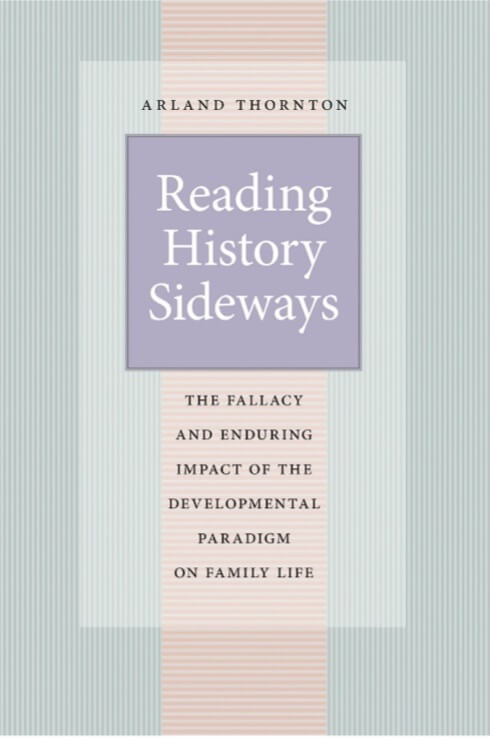
In 2005, Arland Thornton published a fuller treatment of the scholarship informing his Presidential Address in his book, Reading History Sideways: The Fallacy and Enduring Impact of the Developmental Paradigm on Family Life. In the first half of the book, Thornton describes how early scholars’ belief in the developmental paradigm and their method of “reading history sideways” led to flawed conclusions about family life. “Reading history sideways” refers to using cross-sectional data to describe change over time. Believing all societies develop in uniform ways at different paces, scholars used data on contemporary societies perceived as less developed to understand what family life was like during earlier historical periods for societies perceived as more advanced. In the second half of his book, Thornton describes how the resulting collection of beliefs and attitudes about development and family – which he termed developmental idealism – influenced family life over the last two centuries. Learn more about the Reading History Sideways book.
Arland Thornton’s early formulations of developmental idealism theory focused on consequences of developmental idealism for family life and demographic outcomes. He expanded that focus to a wide range of social and economic outcomes in a 2015 Sociology of Development article written with Shawn Dorius and Jeffery Swindle: “Developmental Idealism: The Cultural Foundations of World Development Programs.” In 2015, Thornton also provided an overview of developmental idealism and its origins in a talk at BYU’s Kennedy Center, which was recorded and made publicly available.
During this time, Arland Thornton and several collaborators ran a Development Studies Research Program that included projects in 14 countries, including Nepal, Turkey, China, Iran, and Malawi. Researchers developed measures of developmental idealism and assessed the prevalence and nature of such beliefs and attitudes in many localities around the globe. The Nepal data, collected as part of the Chitwan Valley Family Study (CVFS), are also uniquely able to prospectively connect developmental idealism with subsequent behavior. Many survey modules, as well as focus group guides and other data collection tools, are available at the project webpage.
While developmental idealism theory is relevant to contexts around the globe, much existing work on developmental idealism focuses on non-Western contexts and many have concluded that the theory is not relevant to Western contexts. A 2022 article written by Keera Allendorf, Linda Young-Demarco, and Arland Thornton highlights how developmental idealism is relevant to the United States and other Western contexts: “Developmental Idealism and a Half-Century of Family Attitude Trends in the United States.” Like any context, internal variation allows for expansion of attributes viewed as modern. Uniquely, the United States and other contexts seen as leading the development trajectory also expand attributes and behaviors identified as modern through the extension of core developmental idealism values of freedom and equality.
Currently, a wide range of scholars are engaged in research related to developmental idealism. Some set out to test specific propositions of developmental idealism theory using data from the projects listed here. Others use developmental idealism theory as one theoretical frame among others and use data from a multiplicity of sources. This website provides an incomplete list of publications related to developmental idealism.