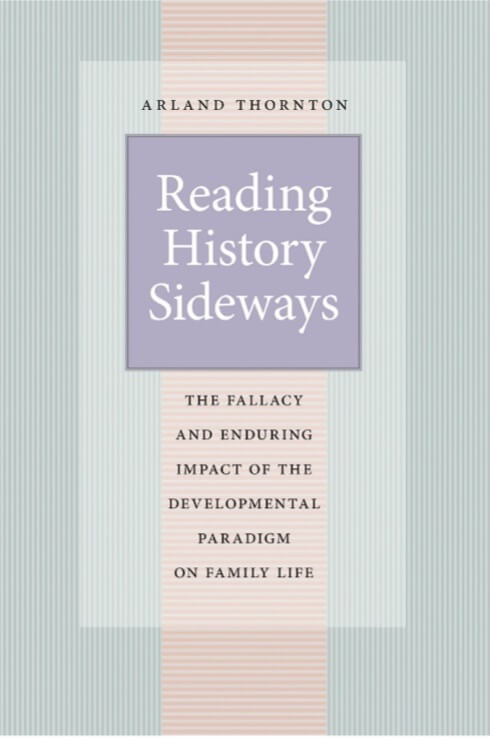
Reading History Sideways: The Fallacy and Enduring Impact of the Development Paradigm on Family Life
by Arland Thornton
University of Chicago Press
2005
Winner of the 2007 William J. Goode Book Award
An award given to the most outstanding contribution to family scholarship in the past two years by the American Sociological Association’s Section on Sociology of the Family.
This book has two main themes:
- 1. How scholars of the late 1700s and 1800s used developmental thinking and “read history sideways” to reach flawed conclusions about family life; and
- 2. How developmental thinking and early scholars’ conclusions about family change – termed developmental idealism – became a powerful force for worldwide family change during the 1800s and 1900s.
Reading History Sideways and Family Myths
European and American scholars from the eighteenth through the mid-twentieth centuries thought that all societies passed through the same developmental stages, from primitive to advanced. Implicit in this developmental paradigm—one that has affected generations of thought on societal development—was the assumption that one could “read history sideways.” That is, one could see what the earlier stages of a modern (Western) society were like by examining contemporaneous so-called primitive societies in other parts of the world.
Based on the contemporary characteristics of societies they viewed as less advanced, scholars of the late 1700s and 1800s believed family life in England and other Northwest European societies in earlier centuries was characterized by great family solidarity, little individualism, overwhelming control of parents over adolescent children, a young age at marriage, universal marriage, marriages arranged by parents, and large households, with children, parents, grandparents, and married aunts and uncles living together. They believed that sometime before they wrote their books there had been a great family transition in Northwest Europe wherein these attributes of family life had been replaced by little family solidarity, great individualism, little control of parents over adolescent children, an older age at marriage, many people never marrying, marriage arranged by the couple through courtship, and small households consisting primarily of parents and children that they observed when writing in the late1700s and 1800s. Beginning in the 1960s, a wave of new family research showed the characteristics of Northwest European family life that had been thought to be of relatively recent origin—the result of the great transformation—had actually existed for many centuries, probably at least back to the 1300s, although data become very sketchy as one moves back in time. These discoveries caused many scholars in recent decades to view the long- believed great transformation of family life as a myth.
Developmental Idealism: An Engine of Worldwide Family Change
The second main thesis of the book argues that developmental thinking and methods of several generations of scholars grew into a powerful set of propositions—termed developmental idealism—that would drive many fundamental changes in family life around the world. Developmental idealism states that a modern society that is industrialized, urbanized, highly educated, and with high levels of knowledge and technology is good and to be sought after. Developmental idealism also indicates a preference for modern families, defined as having high levels of individualism, high status of women, mature marriage, marriage arranged by the couple, the autonomy of children, small households, and controlled and low fertility. Developmental idealism also suggests that a modern society and modern family are causally connected, with a modern society being a cause and/or effect of a modern family system. Finally, developmental idealism emphasizes that individuals have the right to be free and equal, with social relationships based on consent.
Developmental idealism has been disseminated widely around the world—through a myriad of mechanisms—and has been an exceptionally powerful force for family change during the 1800s and 1900s both in Western societies and elsewhere. These changes include declines in childbearing, increases in age at marriage, the increase in the autonomy of young people, growing egalitarianism between women and men, increases in divorce, increases of independent living among both the young and the elderly, increases in sexual activity and cohabitation outside marriage, and the growing emphasis on individual rights as opposed to the norms of the larger community.
Of course, as developmental idealism was disseminated around the world, it met with indigenous social and cultural systems that were also powerful in that they had for centuries provided models for family and social life. It is not surprising that the messages of developmental idealism created substantial tension and conflict with indigenous historical social and cultural systems. In many instances, developmental idealism has been met with sophisticated evaluation, resistance, and adaptation. The end result, however, has been substantial family change during the past two centuries, both in the Western world and elsewhere, with the result often being a hybridized form that mixes indigenous approaches with those of developmental idealism.
Additional Information
Reviews and commentary about the book are available here.
Working papers containing additional material that could not be included in the book are deposited at SocArxiv, comprising:
- Thornton, Arland. 2023 [2005]. “Descriptions of the Reading History Sideways Method (the Comparative Method) by Scholars of the 1700s, 1800s, and 1900s.” https://doi.org/10.31235/osf.io/pezgt
- Thornton, Arland. 2023 [2005]. “Robert Malthus, the Developmental Paradigm, Reading History Sideways, and Family Myths.” https://doi.org/10.31235/osf.io/qwhz8
- Thornton, Arland. 2023 [2005]. “Frederick Le Play, the Developmental Paradigm, Reading History Sideways, and Family Myths.” https://doi.org/10.31235/osf.io/cg3dn
- Thornton, Arland. 2023 [2005]. “Edward Westermarck, the Developmental Paradigm, Reading History Sideways, and Family Myths.” https://doi.org/10.31235/osf.io/2r9na